
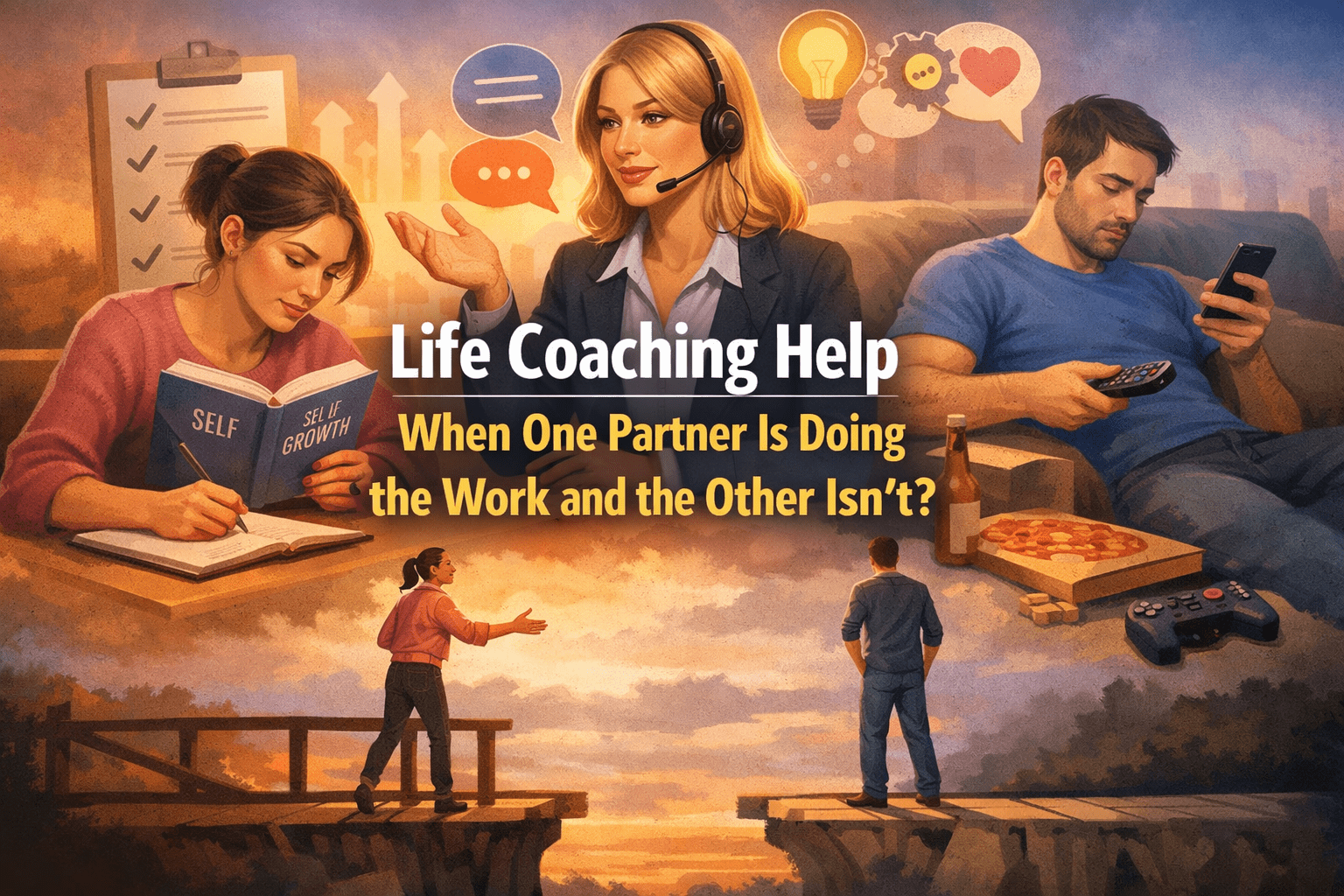
Can life coaching help a relationship if only one partner is changing?
What happens when one partner does the inner work and the other doesn’t?
Is relationship coaching helpful if your partner won’t change?
This is one of the most painful and quietly common questions I hear in my work.
You’re reading, reflecting, noticing your triggers, trying to communicate differently.
You’re taking responsibility for your side of things. And yet, the relationship still feels heavy, stuck, or lonely, because your partner isn’t engaging in the same way.
If you’ve ever thought:
- “I’m growing, but we’re not growing together.”
- “Why do I feel like I’m carrying all the emotional weight?”
- “Is it even possible for this relationship to change if I’m the only one doing the work?”
You’re not wrong for asking. And you’re not broken for feeling exhausted by this dynamic.
The honest answer is nuanced:
Yes, life coaching can help when one partner is doing the inner work and the other isn’t, but not in the way people often hope at first.
Why This Dynamic Hurts So Much
When one person begins doing inner work, awareness increases. You start noticing patterns you once tolerated automatically.
You become more sensitive to tone, withdrawal, defensiveness, or emotional absence, not because you’re becoming “too much,” but because you’re no longer dissociating from what hurts.
I know this dynamic not just professionally, but personally.
My ex-husband was a good and kind man. He was a great provider and a committed husband.

On the surface, everything looked solid. But over time, our relationship became almost entirely transactional, conversations about the kids, the dog, the house, the schedule.
We rarely talked about what we were feeling, what we longed for, or what felt missing.
I spent a long time trying to understand why I was so unhappy and disconnected when nothing was “wrong” in any obvious way.
He was primarily focused on work and the kids, and I kept assuming the disconnection was something I needed to fix inside myself.
This is one of the most confusing parts of this dynamic: when your partner isn’t doing anything overtly wrong, but emotional intimacy is quietly absent. The lack of depth can be harder to name and harder to trust than a clear conflict.
At the same time, your partner may experience your growing awareness as destabilizing.
Even positive change can feel threatening to someone who relies on structure, roles, or productivity to feel safe.
This creates a painful gap:
- One person is moving toward clarity
- The other is often moving toward preservation of the status quo
And the space between those two movements can feel unbearable.
What Life Coaching Can (and Can’t) Do in This Situation

Let’s be clear about what life coaching is not here to do.
It is not about:
- Convincing your partner to change
- Making you more patient so you can tolerate less
- Helping you explain things “better” so they finally get it
My style of coaching is not about fixing you or your partner.
Instead, life coaching helps you understand what’s happening inside you as this dynamic plays out.
That includes:
- The part of you that hopes that if you just grow enough, the relationship will catch up
- The part of you that feels resentful for doing all the emotional labor
- The part of you that’s afraid of what it might mean if nothing changes
When these internal dynamics are seen clearly, the situation becomes less confusing, even if it remains emotionally challenging.
Why One Person Changing Can Still Change the Relationship

Relationships function as systems. When one person shifts how they regulate emotions, set boundaries, and respond under stress, the system is altered, whether the other person intends it or not.
I often use the analogy of a tennis game to explain this. In any rally, how one person hits the ball directly affects how the other person hits it back.
If the ball keeps coming fast, sharp, or reactive, the return will likely be defensive or rushed. When the ball is hit with more ease, the rally naturally changes.

What you can’t control is how the other person chooses to hit the ball back.
They may adjust.
They may not. But the moment you change how you play, how you serve, how you return, how you stay grounded, the entire dynamic of the game shifts.
In my work, I often see that when someone:
- Stops over-explaining
- Stops chasing emotional repair that never comes
- Stops taking responsibility for their partner’s reactions
Something important happens.
The relationship either begins to reorganize in healthier ways, or the truth of the dynamic becomes impossible to ignore.
Both outcomes are forms of progress, even if only one initially feels like the one you want.
The Hidden Trap of “Doing the Work” for the Relationship
One of the hardest things to see is when inner work quietly turns into a strategy for holding the relationship together.
This often sounds like:
- “If I stay calm enough, they won’t get defensive.”
- “If I heal this trigger, maybe I won’t need as much from them.”
- “If I communicate perfectly, this will finally feel mutual.”
This isn’t conscious manipulation. It’s hope.
But when growth becomes a way of abandoning yourself to preserve connection, something essential is lost.
Life coaching helps you gently uncover where your growth has shifted from self-honoring to self-erasing.
What Changes When You Stop Doing the Work For the Relationship
 A pivotal moment often comes when someone realizes:
“I’m not doing this work to save the relationship anymore. I’m doing it to be honest with myself.”
From that place, several things tend to shift:
- Boundaries become clearer and less apologetic
- Emotional reactions feel less overwhelming
- You stop negotiating away your needs internally
Interestingly, this is often the moment when partners either begin to engage differently or when the true limits of the relationship become visible.
Neither outcome is a failure.
When Life Coaching Becomes a Place of Discernment
One of the most important roles my coaching can play in this situation is discernment.
Not:
But:
- “Who am I becoming in this relationship?”
- “What does it cost me to keep hoping this will change?”
- “Am I growing toward myself, or away from myself?”
These are not questions that can be rushed or answered intellectually.
They require space, honesty, and emotional safety.
If You’re Afraid That Choosing Yourself Means Losing the Relationship
This fear runs deep, especially for people who learned early on that connection required adaptation.
It can feel terrifying to imagine that being more grounded, clear, or self-trusting might create distance instead of closeness.
And yet, what I often see is this:
When someone stops contorting themselves to keep the relationship stable, they finally find out what the relationship is actually capable of holding.
That truth, while painful at times, is also liberating.
Can Life Coaching Help If Your Partner Never Does the Work?
Yes.
Because the real work isn’t about synchronizing growth timelines.

It’s about helping you:
- Feel less confused by your own reactions
- Trust yourself again
- Stop minimizing what you’re experiencing
- Respond from clarity rather than fear
From that place, decisions become clearer, not necessarily easier, but more honest.
How This Connects to Relationship Coaching as a Whole
If this question resonates, it’s often part of a larger pattern around emotional labor, responsibility, and safety in relationships.
I explore these dynamics more broadly in my longer article on Can Life Coaching Improve Relationships, where I break down how internal patterns, not effort alone, shape connection, conflict, and emotional intimacy.
Final Thoughts
If you’re doing the inner work and your partner isn’t, it doesn’t mean you’re ahead, broken, or that the relationship is doomed.
But it does mean something important is asking to be seen.
Life coaching won’t tell you what to do. It will help you understand what’s true for you, without pressure, self-betrayal, or false hope.
And from that clarity, the next step, whatever it is, becomes far more grounded.
If you’re navigating this dynamic and want support that honors both your growth and your reality, you’re welcome to explore working with me and see whether this kind of relationship-focused coaching feels like a fit.




0 Comments