

Why staying quiet to keep the peace feels safer than speaking up
Walking on eggshells in a relationship creates emotional distance
What emotional safety in relationships actually requires
You may not realize you are staying quiet in your relationship.
You might tell yourself:
- You are being patient
- You are being understanding
- You are being mature
You avoid bringing things up because it feels easier than dealing with:
- Defensiveness
- Shutdown
- Another fight
Over time, staying quiet to keep the peace does not actually create peace.
It builds:
- Resentment
- Emotional distance
- A growing sense that you are alone in your relationship
You might recognize this pattern as walking on eggshells in a relationship.

You start monitoring:
- Your tone
- Your timing
- Your needs
You do this to avoid triggering:
- Defensiveness
- Shutdown
- Emotional blowups
- Stonewalling
Over time, this self-editing creates emotional distance in couples, even when nothing looks obviously wrong from the outside.
From the outside, your relationship might look stable.
Inside, you may feel like you are shrinking, editing yourself, or quietly carrying too much alone.
That is not what intimacy feels like.
If you need support navigating these patterns and learning how to speak up without fear, my relationship coaching can help you find your voice and strengthen your connection.
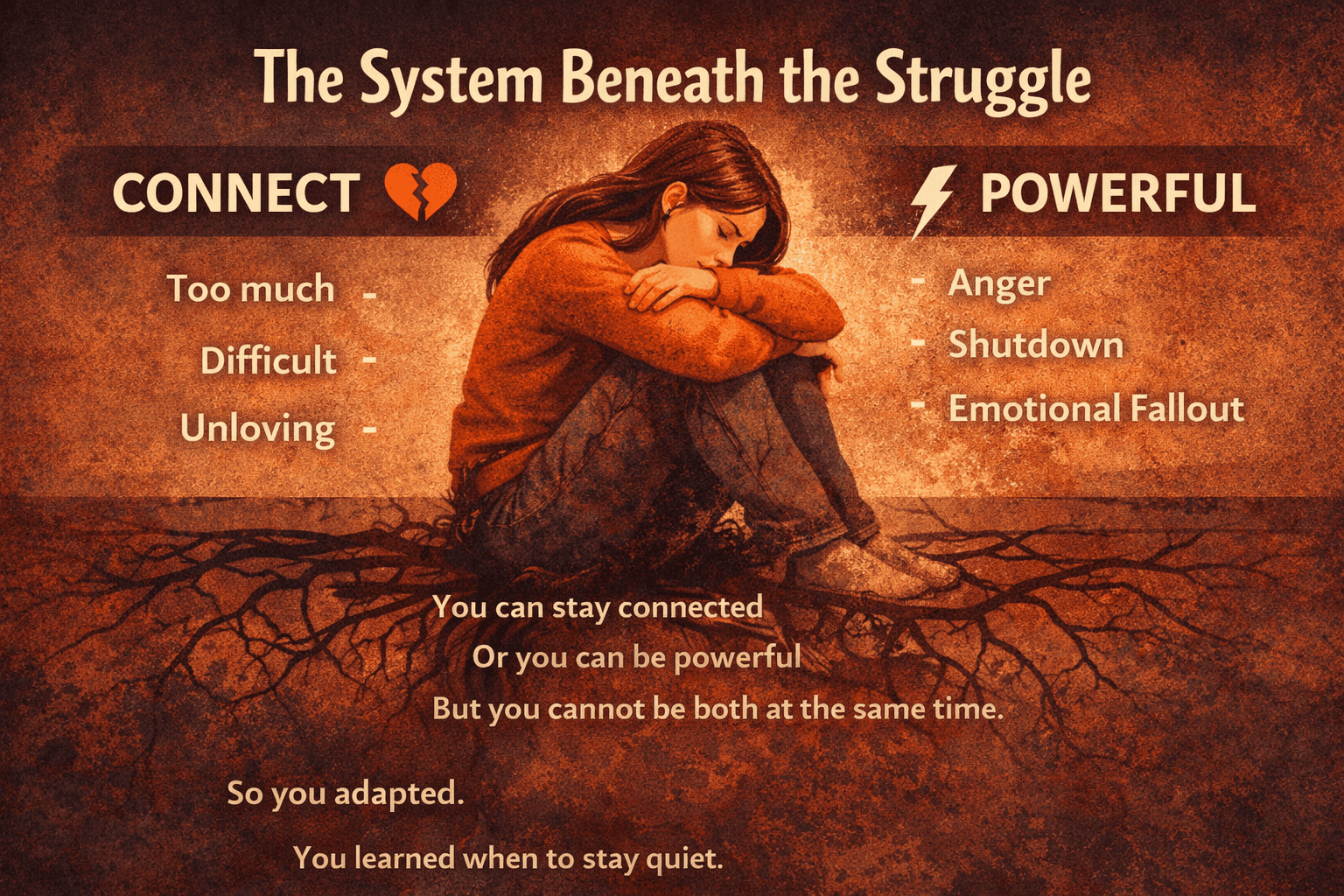
The System Beneath the Struggle
You did not invent this pattern.
You were shaped by a system that taught you something subtle but powerful.

You learned that:
- You can stay connected
- Or you can be powerful
- But you cannot be both at the same time
You may have learned that asserting yourself makes you:
- Too much
- Difficult
- Unloving
You likely learned that speaking up can lead to:
- Anger
- Shutdown
- Emotional fallout
This is why speaking up can feel risky even when your request is reasonable.
So you adapted.
You learned when to stay quiet.
You learned when to smooth things over.
You learned how to read the room and anticipate reactions.
This adaptation may have protected you earlier in life.
In your adult relationship, it quietly costs you closeness.
Silence is not neutral.
Silence creates resentment.
Why Acceptance Without Truth Backfires
You are probably not asking for perfection.
You are asking for:
- Responsiveness
- Repair
- A sense that your relationship can hold honesty without falling apart
When that does not feel possible, acceptance becomes a coping strategy rather than a choice.
This is how resentment in relationships quietly builds.
Not through one big betrayal. But through years of small moments where you chose silence over honesty because of the fear of conflict in relationships.
Patterns such as resistance to speaking up and avoidance of conflict are explored in more depth in Can Life Coaching Improve Relationships?.
Over time, you may feel:
- Less open
- Less generous
- Less connected
This is not because you are broken.
It is because your nervous system learned that honesty feels risky.
Relational Hygiene: Address Issues in Real Time
Healthy relationships require maintenance.

.
Relational hygiene means:
- Addressing small issues early
- Before they harden into resentment
You do not avoid these conversations because you do not care.
You avoid them because:
- You may not have learned how to stay connected while being honest
The question is not whether to speak up.
The question is how to do it without starting another fight.
Skill One: Negotiate the Conversation First
Before you bring up an issue, ask for consent.
Try:
“I need to clear the air with you. Is this an okay time?”
This helps because it:
- Reduces defensiveness
- Prevents ambush
- Creates emotional safety
It also protects you from later being told:
“Why are you bringing this up now?”
This is one of the simplest ways to improve communication in relationships without talking for hours.
Skill Two: Speak With Honesty and Care
You do not have to choose between kindness and truth.

You can be:
- Clear
- Direct
- And still connected
Speaking with honesty and care means saying the truth in a way your partner can actually hear.
That sounds like:
- I love you, and I value what we have.
- When this happens, it feels painful and disrespectful to me.
- I need this to change, and I need reassurance that you are willing to address it.
This is not about managing your partner’s emotions.
It is about speaking from your adult self.
Not from anger, fear, or collapse.
Relational Mindfulness: Which Part of You Is Talking?
In conflict, the most important question is not:
“What is happening?”
The most important question is:
“Which part of me is talking right now?”

.
Common reactive parts include:
- A younger, wounded part
- A protective part
- An appeasing or collapsing part
Most repetitive fights are not adult-to-adult conversations.
There are patterns between protective strategies that once helped you survive but now create distance.
You do not need to get rid of these parts.
They were intelligent adaptations.
You do need to notice when they are running the show and bring yourself back into your adult self.
A helpful reflection:
- What is my go-to stance in conflict?
- Do I pursue, withdraw, escalate, collapse, or appease?
- Where did I learn that?
Adaptive then does not mean adaptive now.
Take Breaks That Build Safety, Not Distance
If you notice yourself getting flooded, take a break.
A break is not a threat.
It is a reset so that you can come back kinder and clearer.
A break works when you:
- Name it
- Say how long you will be gone
- Actually come back
Try:
“I need a break. I will be back in 20 minutes.”
This helps create emotional safety in relationships.
During the break, ask yourself:
- What am I actually about right now?
- Am I trying to make things better?
- Or am I trying to win, punish, or vent?
If your intention is not repair, you are not ready to talk yet.

.
Remember Why You Are Speaking
Before you re-enter the conversation, check your intention.
Ask yourself:
- Am I trying to make things better between us?
- Or am I trying to be right, control, retaliate, or release pressure?
If your intention is not repair, pause longer.
Tone always reveals where you really are.
Real change in communication in relationships often begins when there is enough
emotional safety in relationships for both of you to be honest without fearing retaliation, shutdown, or collapse.
When Vulnerability Feels Hard for Your Partner
If your partner struggles with emotional vulnerability, intimacy is still possible.
It often means:
- They were not taught how to be with emotions safely
This calls for:
- Compassion
- Patience
It does not mean lowering your standards.
You can understand the terrain and still hold the bar high for relational maturity.
The Cost of Silence on Desire
Resentment and passion do not coexist well.
When you stop telling the truth, desire is often one of the first things to go.
Not because you do not care.
But because your body no longer feels safe or open.
This is how resentment in relationships grows.
Quietly.
Over time.
Through small moments of choosing silence because of the fear of conflict in relationships.
You can compromise on logistics.
You cannot compromise on the relationship you live in every day.
From You Versus Me to Us

.
When you are upset, it is easy to slip into:
You versus me.
Who is right?
Who is wrong?
Who should change?
But relationships are ecosystems.
If you pollute the system with anger, you will breathe that pollution in through your partner’s withdrawal.
If one of you wins and the other loses, the relationship still loses.
Winning at your partner is still losing.
Relational growth means learning to think in terms of us, not victory.
When You Are the One Doing the Work
If you are the one growing, practicing these skills, and becoming more aware, this can feel lonely.
You may be:
- Regulating yourself more
- Choosing better timing
- Speaking with more care
While your partner stays in old patterns.
This is especially painful when you are living the pattern of one partner doing the work while the other remains in old relational defenses.
You are not meant to carry the entire relationship alone.

.
If conversations repeatedly derail into retaliation, withdrawal, or shame, outside support is not a failure. It is support.
If you are ready to shift this pattern into real relational safety and connection, you can work with me for support tailored to your situation.
Frequently Asked Questions
Why do I stay quiet to keep the peace in my relationship?
You stay quiet because your nervous system learned that speaking up leads to conflict, defensiveness, shutdown, or emotional fallout.
Staying quiet can feel like protection, but over time, it creates resentment and emotional distance.
Is walking on eggshells emotional abuse?
Not always. Walking on eggshells can happen in relationships where one or both partners have poor conflict skills or high defensiveness.
However, if you feel afraid of your partner’s reactions, experience retaliation for speaking up, or feel consistently unsafe, that is a serious red flag, and you may need support.
How do I bring up an issue without starting a fight?
Start by choosing a good time and negotiating the conversation.
Try, “I need to clear the air. Is now a good time?” Then speak with honesty and care: name the impact, name what you need, and stay focused on repair rather than winning.
What if my partner shuts down or stonewalls when I speak up?
If your partner shuts down, take a structured break instead of pushing harder.
Name the break, say when you will come back, and return as promised.
If the shutdown is chronic and nothing changes, couples coaching or therapy can help you both learn new skills.
Why does resentment affect intimacy and sex?
Resentment and desire do not coexist well.
When you feel unheard, unsupported, or unsafe, to be honest, your body often closes.
Rebuilding intimacy usually starts with truth, repair, and emotional safety.
What if I am the only one doing the work?
You can improve the pattern by changing how you speak, how you time conversations, and how you regulate yourself, but you cannot carry the whole relationship alone.
If you are consistently meeting defensiveness, shutdown, or retaliation, outside support can help you decide what is possible and what needs to change.




0 Comments