
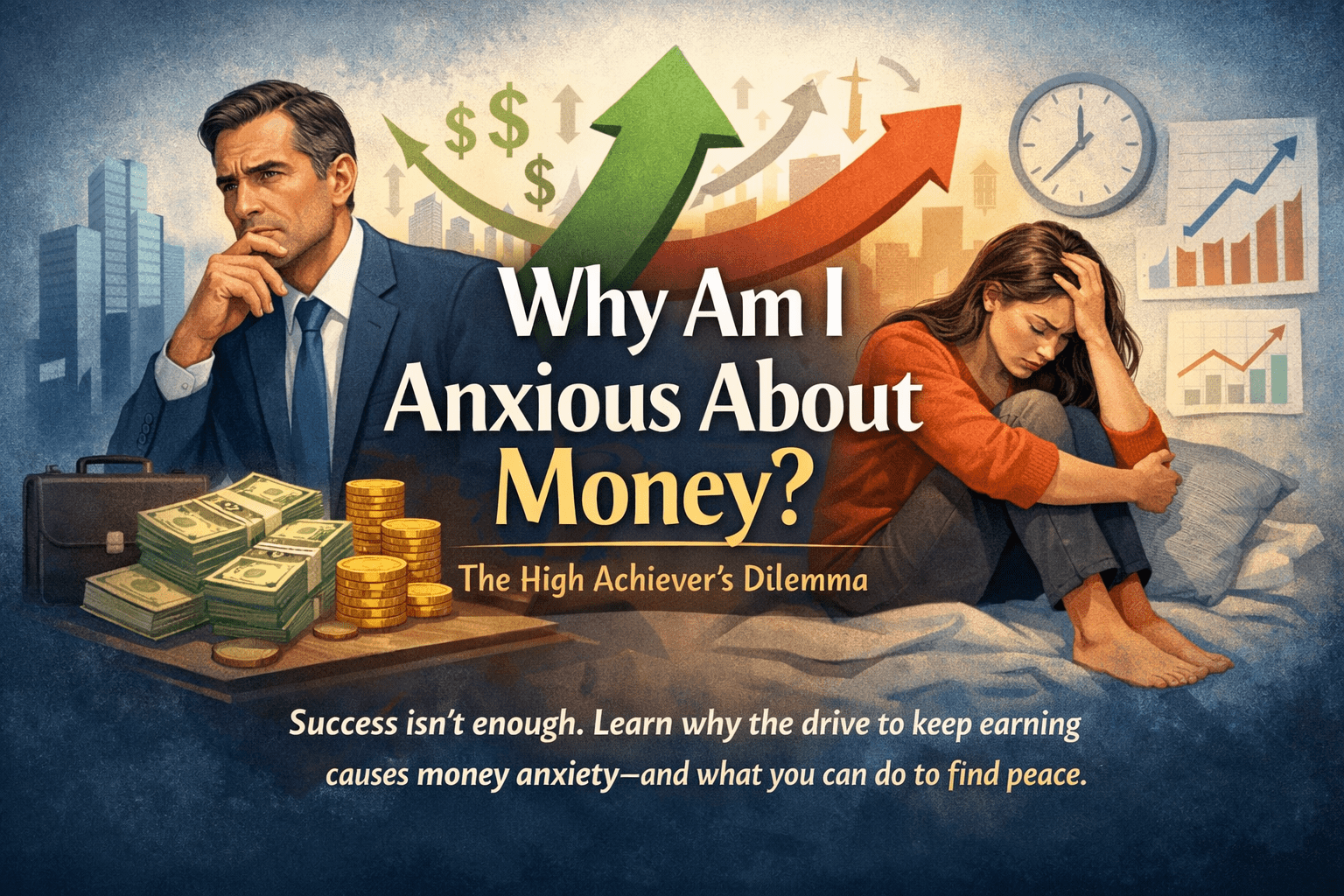
If you already have money but still feel anxious about it, you are not alone.
Many high achievers expect that once they reach a certain level of financial success, the fear will finally disappear.
They assume there will be a moment when everything settles.
A point where they can relax, slow down, and trust that they are secure.
Instead, they often notice something confusing.
- The anxiety does not go away
- The pressure to keep earning remains
- Slowing down feels uncomfortable or even unsafe
Why Am I Anxious About Money
Which leads to a question that is often buried beneath momentum and success:
“Why am I anxious about money even though I have enough?”

This is not a flaw. It is a pattern that once made sense.
Patterns form to keep us safe, especially in environments where safety once felt uncertain.
What once helped you stay ahead may now be what keeps you from feeling at ease.
The question is not what is wrong, but what this pattern has been protecting.
For many high achievers, money anxiety is not about spending too much or fearing immediate loss.
It shows up as a constant internal pressure.
The need to keep going, keep earning, keep momentum alive, even when there is already more than enough.
Understanding why that pressure exists is the first step toward changing your relationship with money.
Not by fixing anything, but by seeing clearly what has been driving it.
What Money Anxiety Actually Is
Money anxiety is a persistent fear, tension, or mental preoccupation related to money that continues even when your financial needs, and often far more, are objectively met.
It is not financial instability.
It is not a lack of discipline or intelligence.
And it is not resolved by earning more.
Common signs of money anxiety in people who already have enough
- Ongoing pressure to keep producing or earning
- Difficulty resting or slowing down
- Anxiety when income plateaus
- Fear of losing what you have built
- A sense that security is temporary
- Restlessness even during success
For high achievers, money anxiety rarely looks like guilt or deprivation.
It looks like relentless forward motion.
Why Having Enough Money Does Not Create Security

Most people assume safety comes from external conditions.
If I have enough money, I will finally feel secure.
But emotional security does not work that way.
Why money does not automatically create safety
- Safety is an internal state, not a financial threshold
- Beliefs do not update just because circumstances improve
- Fear adapts to higher levels of success
If your system learned early on that safety is conditional, money cannot override that belief, no matter how much you have.
External success does not dissolve internal stories.
It often amplifies them.
Feeling safe with money is not about numbers. It is about why money doesn’t create a sense of safety, which I explore in more depth here.
The Belief Underneath “I Have to Keep Making More”
For many people who already have enough, the fear is not about survival.
It sounds more like:
- What I have could disappear
- I am safe because I am still moving
- Slowing down would expose something
At the belief level, money anxiety often rests on conditional safety.
Common underlying beliefs include
- Security must be continuously earned
- Momentum equals protection
- Rest is risky
- Slowing down invites loss
- Enough is never stable
Money becomes less about comfort and more about insurance.
Not against poverty, but against uncertainty, loss of identity, or internal instability.
How Core Beliefs Quietly Drive High-Achiever Behavior
Core beliefs do not stay abstract.
They organize behavior, often in ways that look impressive, driven, and highly functional from the outside, while quietly maintaining pressure on the inside.
Below are some of the most common beliefs I see operating beneath money anxiety in high achievers, and how those beliefs tend to express themselves.
“I’m not enough” → Proving worth through achievement

This belief often drives:
- Relentless productivity
- Overachievement or perfectionism
- Difficulty resting or feeling satisfied
- Needing external markers of success to feel okay
If I keep achieving, I can outrun the feeling of not being enough.
“I’m not lovable” → Demonstrating desirability or usefulness
This belief often drives:
- Attracting partners through success, status, or competence
- Over-giving in relationships
- Providing, rescuing, or financially supporting others
- Needing to be wanted rather than simply known
“If I am impressive or indispensable, I will be chosen.”
“I’m not safe” → Creating control through money, momentum, or planning
This belief often drives:
- Accumulation of wealth beyond practical need
- Constant forward motion
- Hyper-vigilance around risk
- Anxiety when things slow down
“If I stay ahead, I will not be caught off guard.”
“I could lose everything” → Never letting success feel permanent
This belief often drives:
- Fear of plateaus
- Inability to enjoy success
- Constant preparation for the next threat
- A sense that security is temporary
“What I have only counts if I keep protecting it.”
“I’m only valued for what I produce” → Identity fused with output

This belief often drives:
- Difficulty separating self-worth from work
- Anxiety during downtime
- Feeling invisible without productivity
- Resistance to slowing down
“If I stop producing, I will disappear.”
This pattern often overlaps with deeper questions about when self-worth becomes tied to money, which I explore more fully here.
“I’m replaceable” → Staying exceptional or indispensable
This belief often drives:
- Being the hardest worker in the room
- Saying yes too often
- Avoiding delegation
- Needing to be irreplaceable to feel secure
“If I am exceptional, I will not be discarded.”
“I don’t matter unless I’m useful” → Over-functioning in life and relationships

This belief often drives:
- Carrying disproportionate responsibility
- Fixing problems that are not yours
- Difficulty receiving support
- Burnout paired with pride
“My value comes from holding things together.”
“If I relax, something bad will happen” → Chronic tension and urgency
This belief often drives:
- Inability to rest without guilt
- Feeling unsafe in stillness
- Nervousness during calm periods
- Treating stress as protection
“Staying tense keeps me safe.”
These beliefs are not character flaws.
They are adaptive strategies that once made sense.
The behavior is not the problem. It is the evidence.
When Earning Becomes a Safety Strategy
One of the reasons this pattern is hard to recognize is that it does not feel irrational.
It feels responsible.
Momentum creates a sense of control.
Achievement postpones vulnerability.
Staying busy keeps fear at bay.
Over time, the system learns:
I am safe because I am producing.
Earning becomes emotional regulation.
Success becomes protection.
This is why slowing down can feel more threatening than loss, even when finances are secure.
Why Financial Advice Does Not Resolve This Anxiety

People who are anxious about money despite having enough usually do not lack:
- Financial knowledge
- Strategy
- Discipline
- Planning
They have done the right things.
And yet the anxiety persists.
That is because the issue is not behavior or information.
Money anxiety lives at the level of belief, identity, and perceived threat. You can be financially secure and still feel unsafe if safety has never become internal.
How I Work With Money Anxiety at This Level
When I work with money anxiety, I am not treating it as a financial problem to solve.

I view it as a pattern rooted in belief and identity, pervasive among high achievers who already possess money, competence, and success, yet still feel an internal pressure to continue striving.
This work looks very different from the advice.
Instead of asking, How do I make more, I ask a deeper question:
“What does making more protect me from?”
In my coaching, we focus on:
- Identifying the beliefs driving relentless momentum and urgency
- Questioning the assumption that safety is conditional on achievement
- Separating identity and self-trust from productivity and output
- Allowing security to become an internal experience rather than something that must be continuously earned
I am not interested in taking away ambition or dampening drive.
Most of the people I work with are extremely bright, highly capable, and deeply motivated, and that does not need to change.
What does change is the pressure underneath it.
When the belief softens, the compulsion eases, without losing ambition, leadership, or the desire to build.
What emerges instead is a different relationship with money, success, and pace, one rooted in choice rather than fear.
If You See Yourself Here
If parts of this feel uncomfortably familiar, if you recognize the pressure, the momentum, the inability to ever quite feel done, nothing has gone wrong.
It simply means a pattern that once helped you succeed is still running, even though the conditions that created it have changed.
You do not need to dismantle your success to feel at ease.
You do not need to lose ambition to feel safe.
But you may need space to understand what has been driving the pressure, and to let your nervous system and identity update to where you are now, not where you once had to be.
If you are curious about what that shift could look like for you, you can learn more about working with me here.
Conclusion of Why Am I Anxious About Money
Money anxiety can persist even when you have enough money.
For many high achievers, it shows up as pressure to keep earning rather than fear of spending.
This article explains why that happens and what actually helps.




0 Comments